

U.S. oil company shares moved higher on Monday after President Donald Trump signaled that Washington could reassess its sanctions stance toward Venezuela, fueling expectations that American firms may regain access to the country’s vast oil reserves. The market reaction underscored how deeply U.S. sanctions policy remains tied to investor confidence, corporate strategy, and the future of Venezuela’s heavily constrained energy sector.
Venezuela holds the world’s largest proven oil reserves, yet years of sanctions, nationalization, and underinvestment have sharply reduced production. U.S. sanctions, first imposed and later expanded to target the country’s oil exports and state-run energy company, have limited foreign participation and cut Venezuela off from key technology, capital, and markets. As a result, output has fallen to a fraction of its historical peak.
Trump said the embargo on Venezuelan oil exports would remain in place for now. However, his comments about potential U.S. control following the arrest of President Nicolás Maduro prompted speculation that sanctions policy could eventually shift. That possibility alone proved enough to lift energy stocks, highlighting how sensitive markets are to even indirect signals about sanctions relief.
The Trump administration plans to meet with executives from U.S. oil companies later this week, according to a source familiar with the matter. The talks are expected to focus on sanctions compliance, investment conditions, and what role U.S. firms could play if restrictions were eased. Any return to Venezuela would require rapid capital deployment and strict adherence to U.S. sanctions rules, especially given the legal risks tied to past enforcement actions.
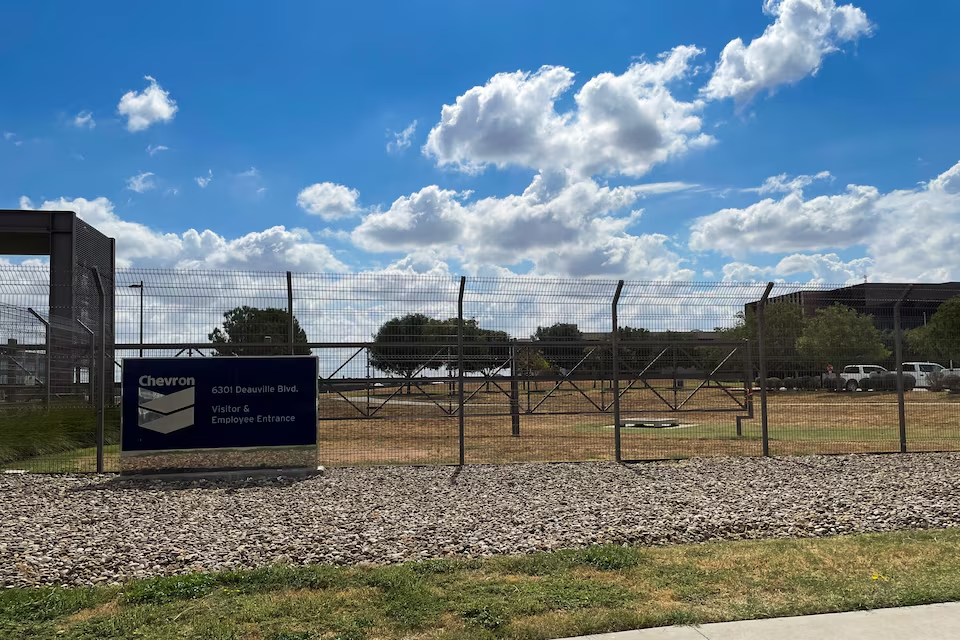
Shares of Chevron, currently the only major U.S. company operating in Venezuela under a limited U.S. waiver, rose about 5%. Chevron’s presence has allowed it to maintain a foothold in Venezuelan fields while navigating sanctions constraints. Analysts say that position could make the company an early beneficiary of any policy change, even as broader sanctions remain intact.
Sanctions have also shaped refinery economics in the United States. Venezuelan crude is a heavy, high-sulfur grade that fits well with U.S. Gulf Coast refineries built decades ago to process similar oil. Restrictions on Venezuelan exports have forced refiners to seek alternative supplies, often at higher cost. As a result, refiners such as Marathon Petroleum, Phillips 66, PBF Energy, and Valero Energy also saw their shares climb on renewed speculation around sanctions flexibility.
Sanctions, seized assets, and unresolved claims
Beyond oil flows, sanctions intersect with long-running disputes over assets seized by Venezuela during the nationalization drive under former president Hugo Chávez. Analysts note that any sanctions adjustment could reopen discussions around compensation for expropriated assets, which remain frozen in arbitration and legal limbo.
Companies such as ConocoPhillips and Exxon Mobil hold sizable arbitration awards linked to assets taken nearly two decades ago. Sanctions have complicated enforcement of those claims, limiting options for recovery. Market optimism suggests investors see a higher chance of progress if U.S. policy toward Venezuela evolves, even incrementally.
At the same time, analysts caution that sanctions relief alone would not restore Venezuela’s oil industry quickly. Infrastructure has deteriorated after years of limited investment, skilled labor shortages persist, and political uncertainty remains high. Moreover, any change to sanctions would likely come with strict compliance conditions and phased implementation to avoid backsliding.