

Argentina’s football establishment is facing mounting turmoil just as the World Cup draws closer, after a series of investigations raised questions about alleged dirty money, unexplained assets, and the role of senior officials inside the sport’s governing body. What began as a cryptic social media post has now escalated into raids, criminal complaints, and a broader debate over transparency at the top of Argentine football.
The controversy traces back to March 2024, when former Argentina star Carlos Tevez posted a message hinting at suspicious activity involving the treasurer of the Argentine Football Association. Tevez alluded to repeated trips to the upscale Buenos Aires suburb of Pilar, suggesting that bags of cash had been hidden there alongside a collection of vintage cars. Although vague, the post drew immediate attention and, soon after, political scrutiny.
In response, the opposition party Coalicion Civica opened its own inquiry. It later filed a criminal complaint centered on a sprawling villa in Pilar, which investigators now suspect may have played a role in laundering money connected to football operations. As a result, the allegations quickly became one of several scandals surrounding the AFA, the organization that governs the sport in the reigning world champions’ country.
Raids, luxury assets, and unanswered questions
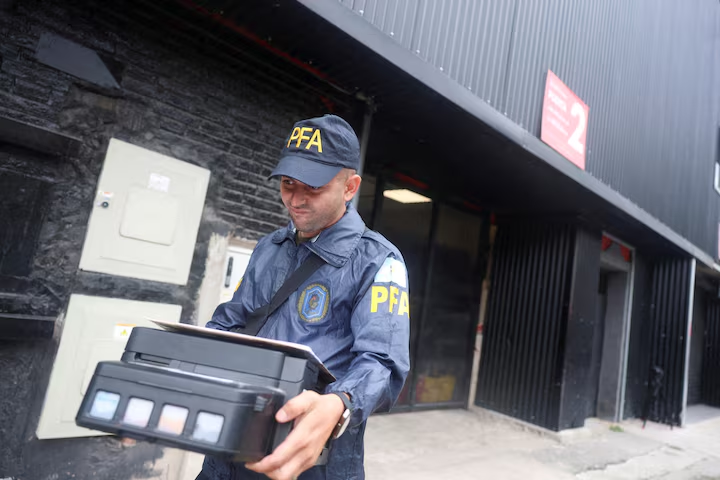
In early December, federal police raided AFA headquarters in Buenos Aires as well as more than a dozen football clubs. Investigators focused on financial transfers involving clubs and a financial services firm. Days later, authorities searched the Pilar property. There, they discovered a heliport, stables, and 54 vehicles, including luxury and collectible cars.
Coalicion Civica alleges the villa served as a front for money laundering linked to AFA president Claudio Chiqui Tapia and treasurer Pablo Toviggino. Both men deny wrongdoing. However, prosecutors have opened multiple lines of inquiry. In a separate case, a prosecutor last week charged Tapia, Toviggino, and other AFA leaders with unlawfully retaining about $13 million in taxes, following a complaint from Argentina’s tax authority.
The AFA has declined to answer detailed questions about the investigations. Instead, it has publicly accused the government of President Javier Milei of targeting the association for political reasons. The dispute reflects a deeper clash, as Milei has pushed to transform Argentina’s traditionally member-run clubs into for-profit entities. The AFA, for its part, has defended its leadership by pointing to Argentina’s on-field success, including its 2022 World Cup triumph.
Meanwhile, investigators continue to examine the Pilar villa’s ownership. According to court filings, the property was purchased in 2024 for about $1.8 million by a company owned by a mother and son, Ana Lucia Conte and Luciano Nicolas Pantano. The complaint argues they could not plausibly afford the purchase. Records also show Pantano’s close ties to football administration. During the raid, police reportedly found items bearing AFA branding and Toviggino’s name, as well as vehicles registered to the same company. Authorities are now seeking flight records linked to the villa’s heliport to identify past visitors.
The justice ministry has widened the spotlight. Officials have asked the AFA and the Superliga, which manages broadcast rights, to explain accounting entries totaling nearly $500 million dating back to 2017. According to regulators, those sums appear under vague balance sheet categories, such as “others,” raising further concerns about transparency.
Despite the gravity of the allegations, experts doubt the investigations will affect Argentina’s participation in the World Cup. Legal analysts say the political cost of punishing the national team would be too high, especially with Lionel Messi likely approaching his final tournament. Still, the scandal has revived long-standing frustrations among fans, who have accused football authorities of favoritism and mismanagement for years.
For many observers, the case has exposed a sharp contrast. On the pitch, Argentine football enjoys global admiration. Off it, however, the sport’s leadership now faces one of its most serious credibility tests in decades.