

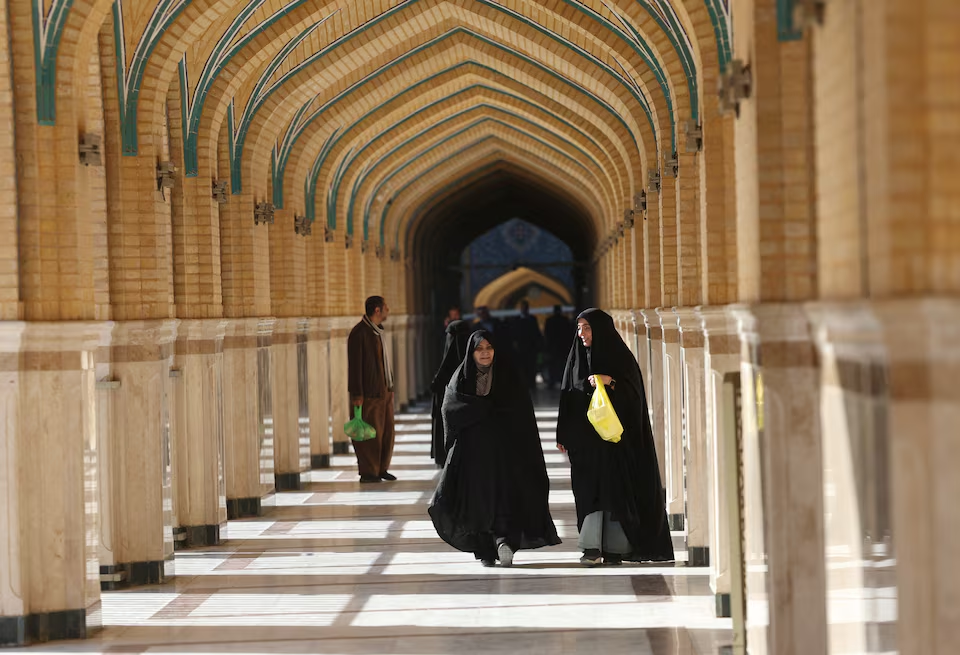
The sharp fall of Iran’s currency is rippling far beyond its borders, hitting livelihoods in Iraq’s holy city of Najaf, where thousands of businesses depend on Iranian religious tourism. As Iran’s rial sinks under the weight of sanctions, inflation, and political unrest, the number of Iranian pilgrims traveling to Iraq has dropped to a fraction of previous levels, leaving shopkeepers and hotel owners struggling to survive.
In Najaf’s old market, Ahmed Salam once ran two stores selling prayer beads and religious accessories to visitors from Iran. Now he operates only one. He sold the other to settle debts after months of weak sales. According to Salam, the prolonged economic crisis in Iran has made travel unaffordable for many pilgrims. He says sanctions imposed on Tehran have not only reshaped Iran’s economy but have also directly hurt communities like Najaf that rely on cross-border religious travel.
Local merchants echo his experience. Najaf hosts the Imam Ali shrine, one of Shi’ite Islam’s most sacred sites. For years, Iranians made up the largest group of visitors, often outnumbering pilgrims from the Gulf, Pakistan, and Lebanon. That flow has slowed dramatically.
Sanctions-driven crisis slashes pilgrim numbers
Industry figures show how steep the decline has been. In 2023, Najaf welcomed between 3,000 and 3,500 Iranian pilgrims each day. Recently, that number has fallen to as low as 100 to 250 on some days. Hotel owners say the collapse has forced widespread closures. According to the city’s hotel and restaurant association, roughly 100 hotels have exited the tourism market since 2020, pushing unemployment higher and hollowing out the local economy.
Currency volatility has played a decisive role. With the rial fluctuating sharply, the cost of a pilgrimage can change overnight. A trip priced at $200 one day may cost $220 the next, creating uncertainty that many families cannot absorb. As a result, even devout pilgrims are postponing or abandoning travel plans.
The downturn reflects deeper turmoil inside Iran. The rial lost nearly half its value against the dollar in 2025 alone. Years of Western sanctions, aimed at curbing Tehran’s nuclear ambitions, have restricted access to global finance and intensified economic pressure. Inflation has surged, officially topping 42% in December, while wages have lagged far behind rising prices.
These pressures have spilled into the streets. Protests erupted late last year over the cost of living and quickly widened into broader demonstrations against Iran’s clerical leadership. State media have acknowledged corruption and mismanagement, while officials blame foreign adversaries for fueling unrest. Human rights groups report thousands of deaths since the protests began, underscoring the depth of the crisis.
For Najaf, the consequences feel immediate and personal. What began as a financial squeeze inside Iran has become a cross-border shock, exposing how sanctions and currency collapses can disrupt informal economies tied to religion and travel. As long as Iran’s economic instability persists, traders in Iraq’s holy cities fear the pilgrims may not return — and with them, the livelihoods that once sustained entire neighborhoods.