

The Thai military said on Monday it had recovered extensive evidence of transnational fraud from a sprawling scam compound in Cambodia, seized during border clashes last year between the two Southeast Asian neighbours.
Speaking to reporters and foreign delegates in Thailand’s Surin province, senior military officials said the O’Smach complex, near the disputed border with Cambodia, had housed thousands of people. Many of them, according to Thai authorities, were victims of human trafficking who were forced to carry out online scams under threat of punishment.
Thai soldiers later escorted journalists through one of several buildings inside the compound that were bombed and then occupied by Thai forces late last year. Inside the six-storey structure, documents were scattered across floors, including what appeared to be long lists of potential scam targets, contact details and prepared scripts used to deceive victims.
O’Smach has previously been identified by the United States as a base for large-scale scam operations, with Washington citing evidence of trafficking and forced criminality linked to the site. Thai officials said the purpose of the media tour was to underline the scale and organization of the alleged criminal activity.
“We want the world to see how this place was being used as a criminal base against humanity,” said Lieutenant General Teeranan Nandhakwang, director-general of the Royal Thai Army’s Directorate of Intelligence.
The briefing comes weeks after Thailand and Cambodia agreed to a ceasefire in late December, ending weeks of intense border clashes — the second such truce in recent months — and halting the most serious fighting between the two countries in years. During the clashes, Thai forces struck several casino complexes along the border, alleging they functioned as scam hubs and were also used to store weapons and coordinate attacks.
Cambodia has rejected those claims. Touch Sokhak, a spokesperson for Cambodia’s interior ministry, told Reuters that Thailand had used the existence of scam centres as a pretext for military action.
He said Cambodia was conducting its own crackdown on scam operations and had pledged to eradicate the illicit industry before April.
According to Thai officials, the materials recovered from O’Smach point to a highly coordinated fraud operation. Among the items seized were 871 SIM cards used for anonymous international communication, dozens of smartphones, counterfeit police insignia and fake uniforms.
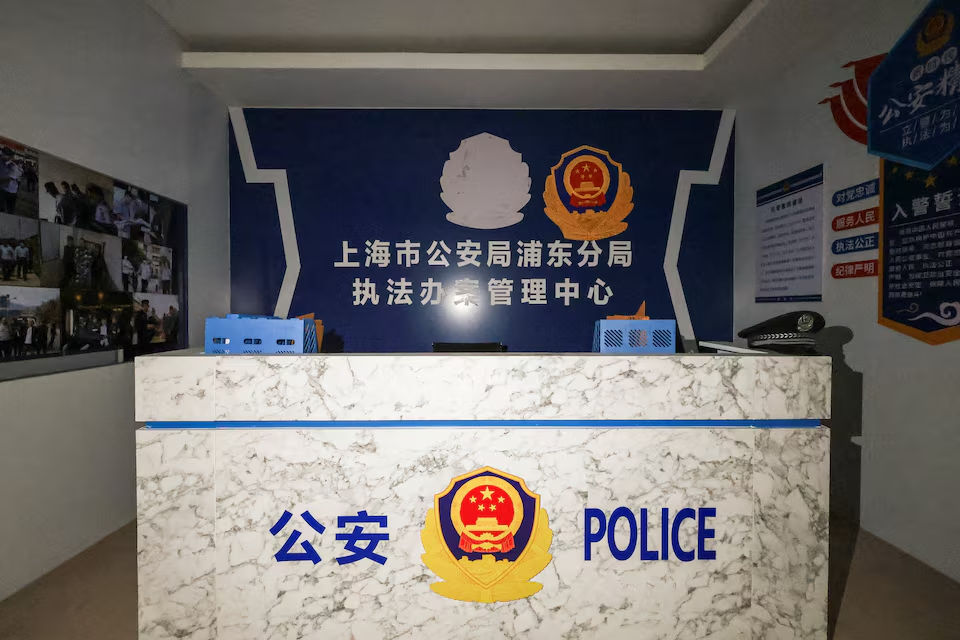
Reporters visiting the compound also saw multiple rooms designed to mimic police offices from different countries. Some were staged to resemble law enforcement facilities from Brazil, China and Australia, an apparent tactic used to intimidate or deceive scam victims into believing they were dealing with legitimate authorities.
Border regions of Southeast Asia, particularly areas linking Thailand, Myanmar and Cambodia, have become major centres for online fraud in recent years. Criminal networks operating from these zones are believed to generate billions of dollars annually, often relying on trafficked workers coerced into running scams targeting victims worldwide.
The evidence presented by the Thai military adds to mounting regional and international scrutiny of the scam economy along Southeast Asia’s borders, even as political tensions and competing narratives between Bangkok and Phnom Penh continue to complicate efforts to dismantle the networks behind it.